
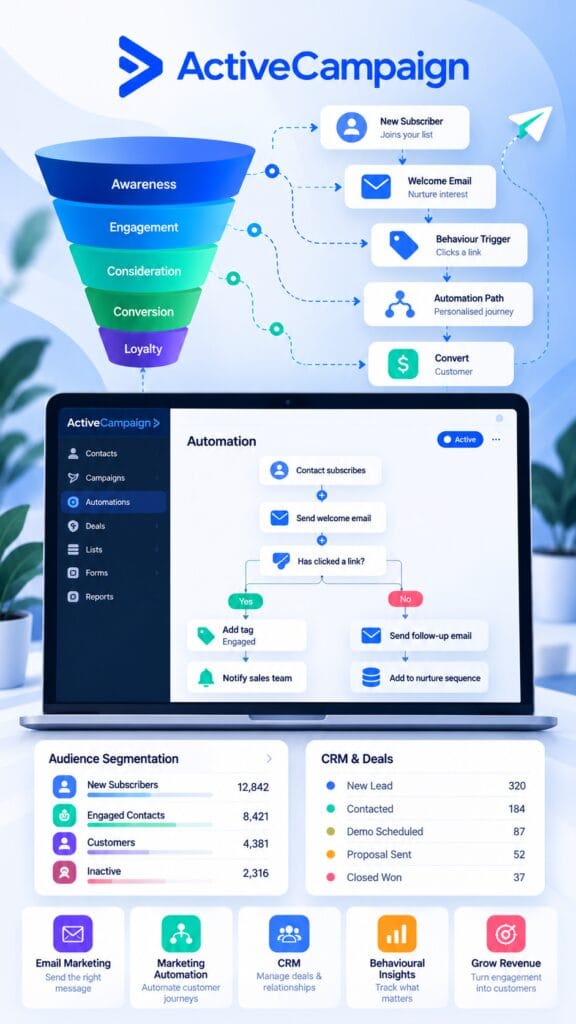
Most businesses start email marketing with a simple goal: collect email addresses and send useful updates to subscribers.
That works well in the beginning. You publish a newsletter, announce a new product, or share a resource with your audience. You send the email, check the results, and move on to the next campaign.
Then the business grows.
You launch another product. Different people download different resources. Some subscribers are ready to buy, while others are still researching. Existing customers need a different message from people who have never purchased anything.
Suddenly, sending the same email to everyone feels less like marketing and more like guesswork.
I’ve worked across different projects and audiences, from e-commerce through Krayah to financial content on Credly. One lesson that applies across these businesses is that collecting contacts is easy. Understanding what to do with them next is the harder part.
This is where ActiveCampaign becomes interesting. It connects email marketing, contact data, and automation into a single workflow, letting businesses respond to what people actually do instead of relying entirely on manual campaigns.
The real question is whether your business has reached the point where that additional capability is worth the investment.
1. When Email Broadcasts Stop Being Enough
A newsletter is useful when you have something relevant to say to a broad audience. The problem begins when different subscribers need different messages.
Imagine you run an online store selling premium apparel. Someone visits your website, signs up for a discount, and leaves without buying anything. Another subscriber has already purchased twice. A third customer has shown interest in a particular collection but has not completed an order.
Would you send all three people the same email?
You could, but you would miss an opportunity to make each message more relevant.
This is the difference between broadcasting and behavioural marketing.
A broadcast sends a message to a selected audience at a particular time. Behavioural marketing uses information about a contact’s interests, actions, and relationship with your business to determine what happens next.
ActiveCampaign supports this approach through contact records, lists, tags, custom fields, segmentation, and automation. Each has a purpose. Lists can organise subscription audiences, while tags and fields help describe a contact’s interests, status, and activity.
For example, a subscriber might have a tag indicating interest in a particular product category. A custom field could record their preferred language, while their purchase history helps identify whether they are a new or returning customer.
You can then use those details to build more relevant segments and campaigns.
The important thing is to plan the structure before creating dozens of tags. Otherwise, your organised marketing system can quickly turn into an untidy database.
2. The Automation Builder: Where the Platform Earns Its Place
ActiveCampaign’s automation builder is one of its most useful capabilities for businesses with repeatable marketing workflows.
Instead of manually deciding who receives every follow-up, you define a set of conditions and actions. The system then runs that process when the relevant triggers occur.
Consider a practical example from financial content.
Someone downloads a guide about choosing a premium credit card. They receive an email with the guide and a short introduction to the subject. Two days later, an automation checks how they have engaged with the follow-up content.
If they click through to a detailed comparison, they can receive more information about the options they explored. If they do not engage, the next email might offer a simpler explanation or another useful resource.
The workflow can also include delays, conditional branches, contact updates, and additional messages.
You are not writing a separate email every time someone takes an action. You are building a process that responds to those actions.
That distinction matters when your audience grows.
The automation can continue running while you work on product development, acquisition, partnerships, or the next campaign. You still need to review performance and improve the journey, but you no longer have to manage every follow-up manually.
One important caveat: the triggers and actions available depend on your integrations, tracking setup, and subscription plan. A website visit, for example, is useful as a signal only when the relevant tracking is configured correctly.
3. Better Segmentation Starts With Better Information
Segmentation is where email marketing becomes more relevant to the individual subscriber.
Let’s return to the apparel store. You are preparing a Black Friday campaign, and you have three broad groups: existing customers, people who have shown interest but never purchased, and subscribers who have not engaged recently.
A single discount email might technically reach everyone, but it does not address their different situations.
Existing customers might respond better to early access to a new collection. Prospective customers might need product comparisons or an introductory offer. Inactive subscribers may need a different reason to return.
With ActiveCampaign, you can create segments using relevant contact fields, tags, engagement information, and other available data.
You might target existing customers who have engaged recently, then send a separate introduction to people who have yet to buy.
This does not guarantee higher conversions. The offer, timing, product, and quality of the audience still matter. What segmentation gives you is a better starting point for delivering messages that make sense for the recipient.
The same principle applies to B2B marketing. A founder researching your services should not necessarily receive the same sequence as a prospect who has requested a consultation.
Relevance is not just about adding someone’s first name to an email. It is about understanding what they are likely to need next.
4. Lead Scoring: Knowing Which Prospects Deserve Attention
For B2B companies and businesses selling high-value services, not every lead is equally ready to buy.
Someone may download a guide because they are curious. Another person may repeatedly visit your pricing page, click a case study, and request a demonstration.
Treating those two people identically can waste your sales team’s time.
Lead scoring helps organise these signals into a more useful picture of engagement. A business can assign different weights to actions, such as clicking a relevant link, viewing a pricing page, or submitting a demo request.
For instance, your team might decide that a pricing-page visit deserves more attention than an ordinary newsletter open. The exact scoring model should reflect your customer journey rather than arbitrary numbers.
When a prospect reaches a defined score, an available automation can notify the sales team, assign a task, or move the contact into another stage of the process.
The benefit is not that a score can predict every purchase correctly. It is that your team gets a more consistent way to prioritise follow-up.
ActiveCampaign offers lead-scoring functionality through its CRM and pipeline options, but availability depends on the selected plan or add-on. Check the current feature details before building your process around it.
5. Connecting Marketing With Sales
Marketing can generate hundreds of leads, but that does not automatically translate into revenue.
The disconnect often appears after someone expresses interest. Marketing sends the lead to sales, but nobody follows up promptly. The salesperson cannot see which content the prospect has read. Marketing continues sending promotional emails even after the person has entered an active sales conversation.
A connected CRM can help reduce these gaps.
ActiveCampaign offers sales pipeline functionality through its CRM options, allowing teams to organise deals by stage and connect relevant marketing activity with sales processes.
A company might use stages such as New Lead, Meeting Booked, Proposal Sent, and Closed Won. Depending on the configured workflow and available features, changes to a deal can trigger tasks, notifications, or follow-up communications.
For example, when a prospect books a meeting, the system could send preparation material. If a proposal remains open, it could remind the salesperson to review the opportunity.
These workflows are useful because they make routine follow-up less dependent on someone’s memory.
They do not replace a good sales process, and not every business needs a built-in CRM. A company with a mature sales system may prefer to integrate ActiveCampaign with its existing CRM instead.
The right choice depends on how your team works and where its customer data already lives.
6. The Learning Curve Is Real
If you are moving from a basic newsletter service, the number of available options can feel overwhelming.
Before building automations, you need to decide how contacts will be organised, which behaviours matter, what information belongs in custom fields, and which actions should trigger each sequence.
Without that groundwork, you can end up with overlapping automations, duplicate messages, inconsistent tags, and subscribers receiving communications that no longer make sense.
Email deliverability also requires attention. Domain authentication, relevant content, consent, list quality, and sensible sending practices all play a role. Moving to a more sophisticated platform does not automatically guarantee inbox placement.
My recommendation is to start with one customer journey rather than trying to automate the entire business at once.
Build a welcome sequence. Test it. Check where subscribers engage or drop off. Make improvements before adding another layer.
That approach is far more manageable than designing a dozen complex workflows before you know whether the first one works.
The Final Verdict: Is ActiveCampaign Worth It?
ActiveCampaign makes the most sense when a business has outgrown basic email broadcasts and needs a more organised way to manage subscriber relationships.
Its strengths lie in connecting contact information, segmentation, automation, and, where appropriate, sales pipeline workflows. These capabilities can reduce repetitive work and help businesses deliver more relevant communications as their audiences grow.
But more features do not automatically mean better marketing.
A small business sending an occasional newsletter may not need elaborate automation. A growing e-commerce brand, B2B business, or company with several customer journeys may benefit much more from the additional control.
Before committing, map out one process you currently manage manually. Work out where people enter, what should happen next, and which conditions should change the journey. Then check whether ActiveCampaign supports that workflow under the plan you are considering.
That is a better way to evaluate the platform than counting features.
Good marketing automation is not about sending more emails. It is about making each follow-up more relevant, without requiring your team to manage every interaction by hand.
If your current email tool feels increasingly difficult to manage as your business grows, take a look at ActiveCampaign’s automation and segmentation capabilities and assess whether they fit the way you work.


 EN
 FR