Expanding your team across borders used to be a logistics nightmare reserved for massive enterprise companies. Today, it is a standard growth strategy for startups and mid-market teams.
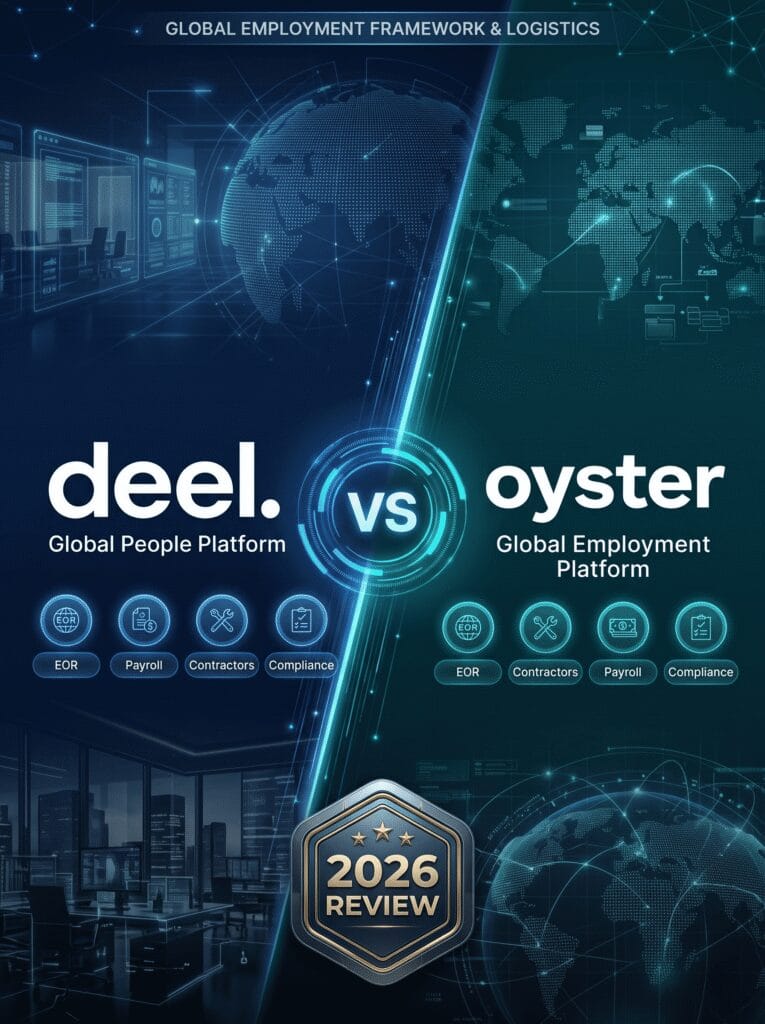
But as global hiring has become more accessible, the software market supporting it has become incredibly crowded. If you are evaluating platforms to help you hire internationally, you have likely narrowed your list down to two of the biggest names in the space: Deel and Oyster HR.
Both platforms promise to take the headache out of global compliance, local taxes, and cross-border payroll. They both look great on a demo. They both have impressive client rosters.
However, when you dig into the actual infrastructure powering these platforms, they are built for very different types of businesses. I spend a lot of time looking at how remote-first companies scale their operations without creating technical debt. The choice between Deel and Oyster HR usually comes down to how fast you are growing, the complexity of your payroll, and how much control you want over your legal infrastructure.
In this deep dive, we are going to compare Deel vs Oyster HR across five critical evaluation criteria. Before we get to the side-by-side comparison, we need to clarify exactly what these platforms actually do.
Understanding the Terminology: EOR vs. Global Payroll vs. Contractor Management
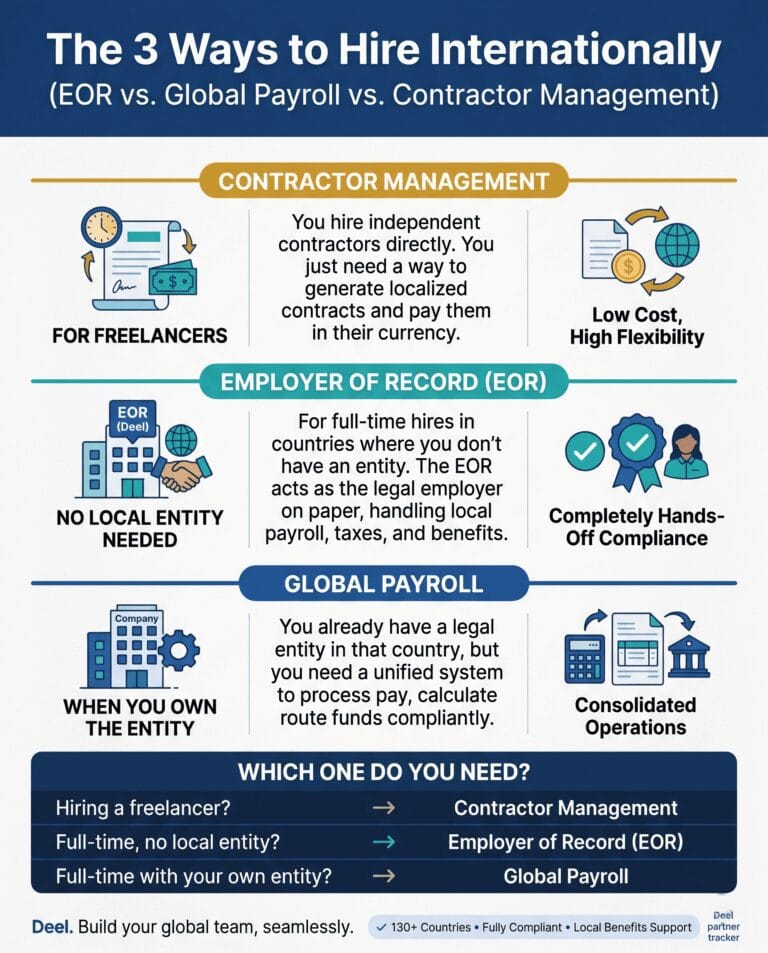
One of the biggest mistakes founders make is buying a platform without understanding the specific legal mechanisms involved. The industry throws around a lot of acronyms. Let us define the three core services you are actually evaluating.
1. Employer of Record (EOR) An Employer of Record is a service that allows you to hire a full-time employee in a country where you do not own a legal corporate entity. The EOR puts the worker on their local payroll, handles the local taxes, and administers statutory benefits. The employee works entirely for your company day-to-day, but the EOR is the legal employer on paper. This is how you hire a developer in France without spending six months and fifty thousand dollars opening a French subsidiary.
2. Global Payroll Global Payroll is entirely different from an EOR. You use global payroll software when you actually do own a legal entity in a foreign country, but you need a system to calculate the taxes, process the payslips, and route the funds compliantly. Managing payroll across five different countries usually means dealing with five different local accounting firms. Global payroll software consolidates all of that into one dashboard.
3. Contractor Management This is for freelancers and independent contractors. You do not need an EOR to hire a contractor. However, you still need a way to generate a localized contract, collect their tax documents, and pay them in their local currency without getting destroyed by international wire fees. Contractor management software handles the logistics and helps you avoid the severe legal risks of worker misclassification.
Deel vs Oyster: The High-Level Comparison Matrix
If you need a quick executive summary, here is how the two platforms compare on their core offerings.
| Feature / Criterion | Deel | Oyster HR | The Verdict |
|---|---|---|---|
| Employer of Record (EOR) Pricing | Starts at $599 / month per employee | Starts at $699 / month per employee | Deel (Saves $1,200+ per year per employee) |
| Contractor Pricing | $49 / month per contractor | $29 / month per contractor | Tie (Oyster is cheaper for basic contractors; Deel offers stronger liability protection features) |
| Legal Infrastructure | 130+ wholly-owned legal entities | 120+ countries via hybrid model (owned and partners) | Deel (Direct control, zero third-party middlemen) |
| Global Payroll Capability | Proprietary in-house payroll engine across 130+ countries | Available but primarily focused around their EOR network | Deel (Superior for transitioning teams to your own legal entities) |
| Misclassification Protection | Dedicated Contractor of Record service (Deel Shield) | Indemnity program available (Oyster Shell) | Deel (Clearer transfer of legal and financial liability) |
| Onboarding & Speed | Tech-forward, highly automated, fast execution | Human-led, heavily supported by HR specialists | Tie (Depends on preference: software speed vs human hand-holding) |
| Ideal Customer Profile | Scaling mid-market and high-growth enterprise teams | Smaller teams prioritizing dedicated local HR support | Deel (Built specifically for frictionless scale) |
Criterion 1: Entity Infrastructure and Country Coverage
The most important feature of any Employer of Record is not the software interface. It is the legal infrastructure sitting beneath the software. When an EOR operates in a country, they do it in one of two ways. They either set up their own wholly-owned legal entity, or they partner with a local third-party staffing agency to act as the legal employer.
How Deel approaches global infrastructure:
Wholly-Owned Entities: Deel has built its own legal entities in over 130 countries. This requires massive capital and years of legal work to establish and maintain.
Direct Control: Because they own the entity, there are no middlemen involved in your hiring process. Deel controls the entire chain of custody for your employee data.
Intellectual Property Protection: Your IP transfers directly from the employee to Deel, and then directly to your company. There is no third-party staffing agency in the middle holding your proprietary code or marketing assets.
Speed of Resolution: If a payroll issue occurs or you need to terminate an employee quickly, you deal directly with Deel. You do not have to wait for them to contact a local partner who then contacts the employee.
How Oyster approaches global infrastructure:
The Hybrid Model: Oyster supports hiring in over 120 countries. They achieve this by combining their own legal entities with local third-party partners.
High Owned Percentage: Oyster reports that over 80 percent of their hires happen on their own entities. This is a strong metric for core international markets like the UK or Canada.
The Third-Party Friction: In smaller or more complex regulatory markets, you might be relying on a partner network. This introduces a middleman into your human resources stack.
Communication Delays: Onboarding and support tickets can take a few extra days in partner countries. The data must pass from your company to Oyster, and then finally to the local partner for processing.
The Real-World Scenario: Imagine you need to let an employee go in a highly regulated market like Germany. The termination process is incredibly strict. With Deel, their internal German legal team handles the paperwork directly. With Oyster’s partner model in certain regions, your termination request goes to Oyster, who passes it to a local agency, who executes the termination. That extra layer of communication can lead to costly delays when managing sensitive HR issues.
Criterion 2: Pricing Structure and True Cost of Scale
When you are scaling a global team, a difference of a hundred dollars per employee per month compounds rapidly. You have to look at the baseline subscription cost alongside the hidden fees that accrue over time.
Deel Pricing Breakdown:
EOR Pricing: Starts at $599 per employee per month. This is one of the most competitive baseline rates in the premium EOR market.
Contractor Pricing: $49 per contractor per month. This provides access to localized contracts and automated invoicing.
Global Payroll: Custom pricing based on headcount and the specific countries involved.
Volume Discounts: Deel is known to offer aggressive volume discounts for enterprise teams scaling rapidly.
Oyster Pricing Breakdown:
EOR Pricing: Starts at $699 per employee per month. This base rate is significantly higher than Deel.
Contractor Pricing: $29 per contractor per month. They also offer the first month free for new contractors.
Scale Pricing: Oyster offers a “Scale” tier for companies hiring five or more EOR employees, which brings the price down closer to Deel, but exact figures require a sales call.
The Real-World Scenario: Let us look at the math for a growing startup. If you plan to hire twenty full-time international employees over the next year, Deel will cost you roughly $143,000 annually in software fees. Oyster will cost you roughly $167,000 annually at their standard rates. Deel saves you $24,000 a year purely on base Employer of Record fees. That is enough capital to hire an entirely new junior developer. Oyster provides a slight cost advantage only if your workforce consists entirely of contractors and you want the absolute lowest monthly fee possible.
Criterion 3: Global Payroll Capabilities
As companies mature, they often transition from using an EOR to opening their own legal entities in countries where they have a high concentration of staff. When you make that transition, you still need a robust way to pay those people.
Deel’s Global Payroll Ecosystem:
Proprietary Payroll Engine: Deel is not just an EOR. It is a massive global payroll provider. They run their own in-house payroll engine across more than 130 countries.
Seamless Transitions: If you have twenty employees on an EOR in Spain, and you decide to open your own Spanish entity, you can easily transition those employees over to Deel Global Payroll.
Unified Dashboard: You keep the exact same software interface, the same reporting structure, and the same payout mechanics. The employee experience never changes.
Consolidated Reporting: Your finance team can pull one single report that shows the total cost of your workforce across contractors, EOR employees, and direct entity employees.
Oyster’s Global Payroll Approach:
EOR First Focus: Oyster handles global payroll for companies that own their own entities, but they keep this capability much more closely tied to their core international employment platform.
Less Standalone Infrastructure: Oyster is fundamentally built to be an Employer of Record platform. While their payroll tools are functional, they do not market themselves as a standalone enterprise payroll replacement in the same aggressive way Deel does.
Partner Reliance: Running direct payroll through Oyster in certain regions may lean on their network of local accounting partners rather than a purely proprietary software engine.
The Real-World Scenario: Your company just hit Series B funding. You have forty employees on an EOR scattered across Europe, but fifteen of them are in the UK. Your CFO decides it is time to open a UK entity to save on EOR fees. If you use Deel, you just flip a switch in the backend to move those fifteen people from the Deel EOR to Deel Global Payroll under your new UK entity. If your platform lacks a strong, standalone global payroll product, you will have to undergo a massive data migration to a totally new software vendor.
Criterion 4: Contractor Management and Misclassification Risk
Managing contractors internationally carries a massive hidden risk known as worker misclassification. If local authorities decide your contractor is actually acting as an employee, you face brutal financial consequences.
How Deel handles contractor compliance:
Localized Agreements: The platform automatically generates contracts that comply with the specific labor laws of the contractor’s home country.
Tax Document Collection: Deel automatically collects necessary tax forms like the W-8BEN or W-9 before the first payment goes out.
Deel Shield (Contractor of Record): This is a massive differentiator. For $325 a month, Deel will thoroughly vet the working relationship and act as the legal employer of the contractor. If a foreign government ever challenges the classification and issues a fine, Deel assumes the financial and legal liability. You are completely protected.
How Oyster handles contractor compliance:
Basic Contractor Tools: Oyster provides standard localized contracts and automated invoicing for contractors in over 180 countries.
Lower Entry Cost: At $29 a month, it is an extremely affordable way to centralize your freelancer invoices.
Oyster Shell Indemnity: Oyster offers a protection program called Oyster Shell to help indemnify companies against misclassification.
Less Transparent Liability Transfer: Oyster does not heavily market a standalone Contractor of Record service with the exact same level of total liability transfer as Deel Shield. Their focus remains heavily on pushing companies to convert contractors into full-time EOR employees to ensure compliance.
The Real-World Scenario: You hire a freelance graphic designer in London. You require them to work from 9 AM to 5 PM, you provide them with a company laptop, and you forbid them from taking other clients. The UK government audits your company and declares this person is a full-time employee under the IR35 legislation. You now owe two years of back taxes, pension contributions, and holiday pay. If you used Deel Shield, Deel covers those penalties. If you used basic contractor management software, your company writes the check.
Criterion 5: Platform UX and Compliance Support
International employment rules change constantly. Tax brackets shift, mandatory pension contributions update, and new labor laws pass. Staying compliant requires a mix of great software and human expertise. Deel and Oyster take fundamentally different approaches to solving this problem.
The Deel UX and Support Experience:
Automated Compliance: Deel leans heavily into technology. They use automated tools to constantly monitor regulatory requirements and flag potential issues immediately inside your dashboard.
Speed of Execution: This tech-forward approach allows you to move incredibly quickly. You can generate compliant contracts and onboard new hires with minimal friction.
Rapid Onboarding: Because they rely on software and owned entities, Deel can often get employees fully onboarded in as little as a few days.
In-App Chat Focus: Support is primarily handled through an efficient 24/7 in-app chat system, designed for founders who need quick tactical answers at midnight.
The Oyster UX and Support Experience:
Human-Led Guidance: Oyster puts a massive emphasis on combining their software with dedicated HR experts and country specialists.
White-Glove Service: If you are navigating a tricky cultural nuance or a complex benefits package in a new market, Oyster provides human specialists to step in and guide your HR team.
Detailed Knowledge Base: Their platform is built around educating your team on local labor laws, offering deep insights into expected cultural norms for hiring.
Slightly Slower Pacing: Because they rely more heavily on human intervention and partner networks, onboarding complex hires might take slightly longer compared to a purely automated system.
The Real-World Scenario: You are expanding into France for the first time. The French labor code is notoriously complex. If your internal HR team is small and nervous about making a mistake, they might prefer Oyster. The Oyster team will actively hold their hand through the complexities of the 35-hour workweek and local health insurance. However, if you are a fast-moving startup that just wants to get a French developer coding by next Tuesday, Deel’s automated workflow will get you to the finish line much faster.
The Final Verdict: Which Platform Fits Your specific Use Case?
Both Deel and Oyster are premium, highly capable platforms. Recommending one over the other requires looking at exactly how your business operates.
When to Choose Oyster HR: Oyster is the right choice if your international footprint is small, and your primary focus is on the localized employment experience rather than scaling massive infrastructure. If you are hiring a handful of full-time employees in complex markets and you want dedicated, human-led HR support to guide you through the cultural and legal nuances, Oyster shines. Additionally, if your workforce is 95 percent independent contractors and you simply want a basic, low-cost platform to manage their invoices, Oyster’s $29 contractor fee is highly appealing.
When to Choose Deel (The Definitive Use Case): You should choose Deel if you are an ambitious, fast-growing company building a mixed workforce of contractors and full-time employees across multiple regions.
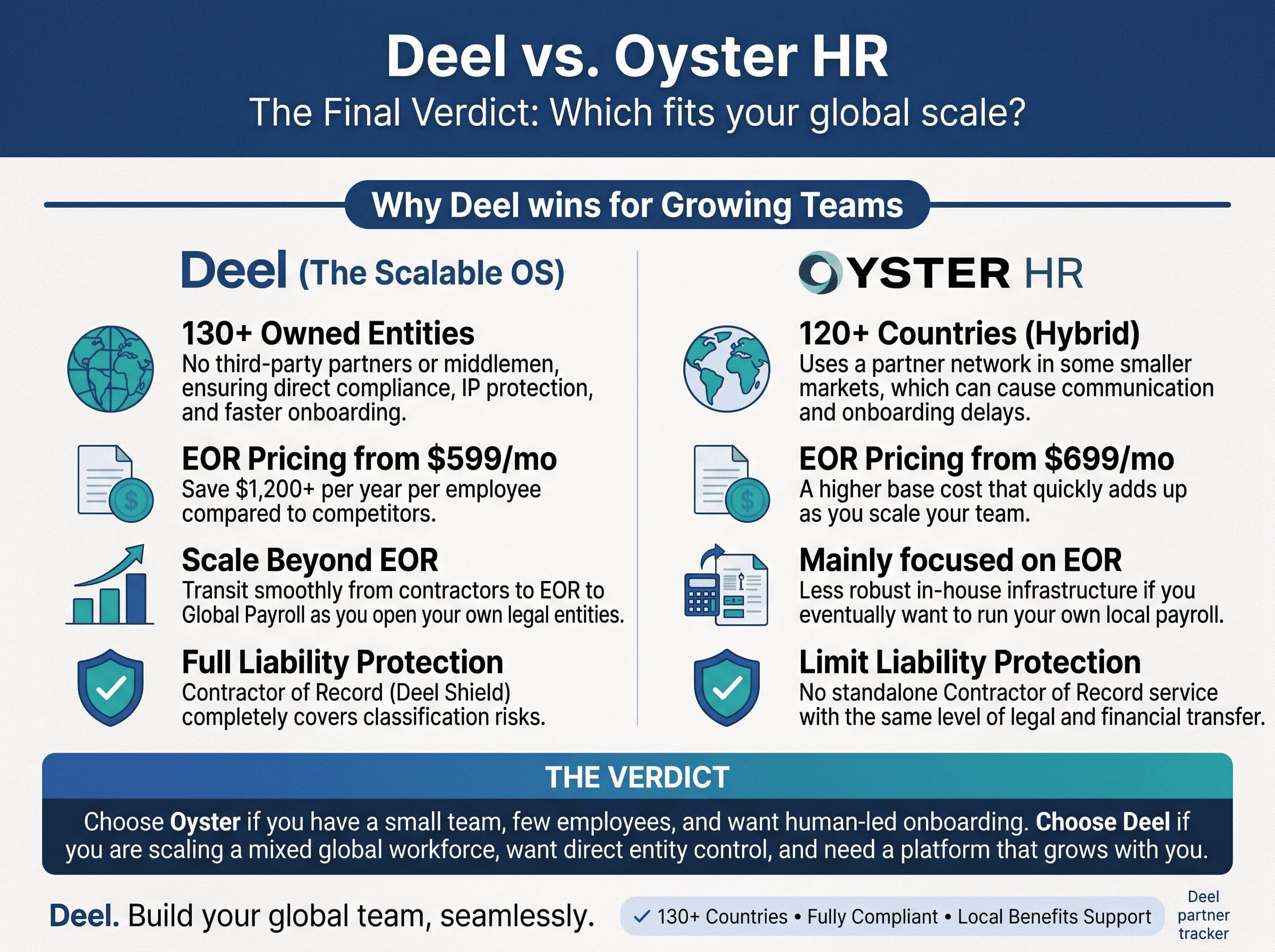
Deel is built for scale. Because they own their entities in over 130 countries, they remove the friction and delay of dealing with third-party partners. Their EOR pricing is $1,200 cheaper per employee per year than Oyster. More importantly, Deel gives you room to grow. You can start by hiring a contractor, easily convert them to an EOR employee when the time is right, and eventually transition them to your own global payroll when you establish a local entity. You never have to rip and replace your software stack.
Deel does not just handle international hiring. They have built the definitive operating system for global workforce management.
If your team is ready to scale operations, centralize your global payroll, and cut your EOR costs, Deel is the clear winner.
Ready to build your global team? Book a demo with Deel right here to see the platform in action here.
To read about the Deel vs. Remote review, click here.


 FR
 EN